"There is no reason why, in a society which has reached the general level of wealth ours has, the first kind of security should not be guaranteed to all without endangering general freedom; that is: some minimum of food, shelter and clothing, sufficient to preserve health. Nor is there any reason why the state should not help to organize a comprehensive system of social insurance in providing for those common hazards of life against which few can make adequate provision" Hayek (1944)
Thursday, June 10, 2010
Hayek, the "socialist"
Has Glenn Beck actually read The Road to Serfdom? If so, I would like to know his take on this:

Thursday, June 3, 2010
Markets in everything: Kaggle
Kaggle is a website to set up prediction competitions. What a great idea! Somebody uploads the data, and number crunchers all over the world will compete for the best predictions. The themes range from the mundane (Eurovision voting *) to the important (HIV progression).
(HT More or Less).
(*BTW,the unexpected winner of Eurovision 2010 is the perfect guilty pleasure song).
(HT More or Less).
(*BTW,the unexpected winner of Eurovision 2010 is the perfect guilty pleasure song).
Wednesday, June 2, 2010
Strange world: industrial tourism
The last French trend. Amazon.fr has even a section on the subject. (But I'd rather visit the 300,000 workers Foxconn unit in Shenzen.
Saturday, May 29, 2010
Books on Brazil
Tyler Cowen's post on "The culture that is Brazil" reminded me of how important it is to read foreigners account on our home countries. ("Closing banks on soccer games"? What is wrong in that?"). I do appreciate reading guide books on Brazil and I have a few notes about them:
- How to Be a Carioca: The Alternative Guide for the Tourist in Rio is a non-academic anthropology book, disguised as book guide, on contemporary Brazil. Strongly recomended for tourists, researchers (and Brazilians). But you will need a traditional guide book for the practical stuff;
- Lonely Planet Brazil : far from complete and full of mistakes. I guess that it is the first or second LP edition on Brazil, so I hope it will improve.
- Culture Shock! Brazil: A Survival Guide to Customs and Etiquette: It is a must if you intend to reside in Brazil. It is not aimed to tourists, but has lots of practical info. (I bought it because a German couple told me that the book was funny. It isn't).
Tuesday, May 25, 2010
A Jane Jacobs' neighborhood is not an equilibrium situation
I guess that this is the point of this article/review Gentrification and Its Discontents.
Saturday, May 22, 2010
Thursday, May 20, 2010
Sentences you will never read in a published paper
 If I were sincere, I'd have written half of the sentences. HT NPTO
Wednesday, May 19, 2010
I suspect...
...that physicists say the G-word just to get research funds from scientific illiterate politicians. (See the last line)
Tuesday, May 18, 2010
Taxation, Lobbies and Welfare in an Enclave Economy: Rubber in the Brazilian Amazon 1870-1910
I've met Felipe Tãmega in 2006. He was a graduate student in economic history at the LSE and Colin Lewis was his thesis supervisor. At first glance it was obvious that he was a really talented young man and a nice chap. Google led me to this very interesting paper from him (I guess it is part of his PhD thesis):
Taxation, Lobbies and Welfare in an Enclave Economy: Rubber in the Brazilian Amazon 1870-1910Now he is at the Harvard Business School. Great! Congratulations!!!
Abstract
This paper uses an enclave economy (Brazilian Amazon) to show that [export] taxes can be welfare enhancing and be used as instruments to move the economy away from the immiserizing growth path. Nonetheless, the results show that the government could have raised the Brazilian Amazon's welfare with a much higher export tax, and offers political-economic reasons why it did not.
Wednesday, May 12, 2010
Colonial Institutions, Slavery, Inequality, and Development: Evidence from São Paulo, Brazil
- Everybody is talking about the new paper from William Summerhill. Abstract:
Cool stuff.
Brazil is frequently portrayed as exhibiting persistent and structural economic inequality that is rooted in the early colonial experience, and is believed to undermine development in the long run. I construct original measures of agricultural inequality for 1905 in what is today Brazil’s largest state, using farm-level micro data for some 50,000 farms. Using these measures of inequality, along with contemporary covariates and other historical variables I assess the impact of colonial institutions, slavery, farm inequality, and political inequality on long-term development in São Paulo. The principal findings are: (1) a potentially coercive colonial institution, the aldeamento, is positively correlated with income per capita at the end of the twentieth century; (2) measures of the intensity of slavery have little if any independent impact on income in 2000; (3) farm inequality was not persistent in São Paulo at the county level over the twentieth century; (4) in both OLS and IV estimates, no negative effect can be found for 1905 inequality on long-term development; (5) political inequality in the early twentieth century, measured by the extent of the franchise, is unrelated to contemporary farm inequality, and also unrelated to long-term economic growth; and (6) the provision of local public goods in the early twentieth century, measured by local public education outlays, has a positive impact on long-term development, but was not related to contemporary economic or political inequality. Overall, neither the intensity of slavery nor the pattern of inequality had any discernable negative economic impact in the long run.
Cool stuff.
Thursday, May 6, 2010
Maps! Maps! Maps!
The Beauty of Maps:the dark side of the moon, XVI century Constantinopla, the Universe and beyond... (HT do Breno Baldrati)
Maps: Power, Plunder and Possession:
BBC docs are blocked outside the UK, so you have to find another way to download them.
Maps: Power, Plunder and Possession:
BBC docs are blocked outside the UK, so you have to find another way to download them.
Wednesday, May 5, 2010
The first law of tourism
There is an inverse relationship between the reputation of hospitality of a country and its number of tourist attractions.
Tuesday, May 4, 2010
Reboot of the European airspace
after the eruption of the I-dunno-how-to-spell-it volcano:
HT Caio Cardim.
Monday, May 3, 2010
Sunday, April 18, 2010
The funniest paper ever published in "American Economic Review"
In fact, only cliometricians (and their enemies) will laugh:
"Shatter and Filth (1975) consider "what if Fogel had never written his article" and projected that economic historians would have turned to cocaine use instead of counterfactuals."
"The new economic geography, now middle-aged" by Krugman
Krugman's talk at the Association of American Geographers. (It happened two days ago. Oh boy, I do love the internet). Highly interesting, especially when he argues that NEG is still useful to understand contemporary issues:
"... new economic geography has a kind of steampunk feel, so that the stories it tells seem more suited to the U.S. economy of 1900 than that of 2010. Well, China is an economic powerhouse, but it’s still quite poor; .., China today appears to have roughly the same level of per capita GDP as the United States at the beginning of the 20th century.(Via Brad Delong)
And guess what? Chinese economic geography is highly reminiscent of the economic geography of advanced nations circa 1900 – and it fits gratifyingly well into the new economic geography framework."
Wednesday, April 14, 2010
The Future of Regional Economics
A special issue of the Journal of Regional Science. Everybody is there: Duranton, Overman, Puga, Glaeser, Storper, Thisse...
I haven't read the papers, but the best title is: " The data avalanche is here: shouldn't we be digging?".
(HT Bruno Cruz)
I haven't read the papers, but the best title is: " The data avalanche is here: shouldn't we be digging?".
(HT Bruno Cruz)
Tuesday, April 13, 2010
The Red Water Ordeal
Nathan Nunn on the many ways to produce slaves in Guinea-Bissau
The chief of the Cassanga used the “red water ordeal” to procure slaves and their possessions. Those accused of a crime were forced to drink a poisonous red liquid. If they vomited, then they were judged to be guilty. If they did not vomit, they were deemed not guilty. However, for those that did not vomit this usually brought death by poisoning. Their possessions were then seized and their family members were sold into slavery."The Long Term Effects of Africa's Slave Trade" Quarterly Journal of Economics, Vol. 123, No. 1, February 2008, pp. 139-176.
Saturday, April 3, 2010
Wednesday, March 31, 2010
The new applied econometrics
The Credibility Revolution in Empirical Economics: How Better Research Design is Taking the Con out of Econometrics by Angrist and Pischke. Experiments and good instruments are the way to go.
Monday, March 22, 2010
Saturday, March 20, 2010
North Korea, the worst place on Earth
- The former chief of the planning and finance department of the Workers' Party was executed;
- Reality X Fantasy.
Friday, March 19, 2010
Brazilian spatial dynamics in the long term (1872–2000): “path dependency” or “reversal of fortune”?
The Journal of Geographical Systems has just published my paper . (In the same issue there is a very interesting study "From locational fundamentals to increasing returns: the spatial concentration of population in Spain, 1787–2000" )
Thursday, March 18, 2010
Tuesday, March 9, 2010
Monday, February 22, 2010
Natural Experiments of History - Diamond and Robinson (ed.)
Jared Diamond ("Guns Germs and Steel") and James Robinson ("Reversal of Fortune" with Acemoglu and Johnson) have edited the book. The table of contents is impressive!:
1. Controlled Comparison and Polynesian Cultural Evolution
Patrick V. Kirch
2. Exploding Wests: Boom and Bust in Nineteenth-Century Settler Societies
James Belich
3. Politics, Banking, and Economic Development: Evidence from New World Economies
Stephen Haber
4. Intra-Island and Inter-Island Comparisons
Jared Diamond
5. Shackled to the Past: The Causes and Consequences of Africa's Slave Trades
Nathan Nunn
6. Colonial Land Tenure, Electoral Competition, and Public Goods in India
Abhijit Banerjee and Lakshmi Iyer
7. From Ancien Régime to Capitalism: The Spread of the French Revolution as a Natural Experiment
Daron Acemoglu, Davide Cantoni, Simon Johnson, and James A. Robinson
* Afterword: Using Comparative Methods in Studies of Human History
Jared Diamond and James A. Robinson
Sunday, February 21, 2010
Saturday, February 20, 2010
Physics envy
"Any scientist who doesn’t have physics envy is an idiot."
J.M. Epstein in REMARKS ON THE FOUNDATIONS OF AGENT-BASED
GENERATIVE SOCIAL SCIENCE. (HT Bernardo Furtado)
J.M. Epstein in REMARKS ON THE FOUNDATIONS OF AGENT-BASED
GENERATIVE SOCIAL SCIENCE. (HT Bernardo Furtado)
Friday, February 19, 2010

Thursday, February 18, 2010
Wednesday, February 17, 2010

Sunday, February 7, 2010
New movies
- Moon (2009)-a retro sci-fi movie. Kevin Spacey is the voice of the computer
HalSam. - The invention of lying - At first glance, it is another feel-good movie from Hollywood. It is not. Thanks, Ricky Gervais.
- Flood with love for the kid. A one man remake of do Rambo First Blood (!?!?!?). The critics say it is great.
Friday, February 5, 2010
Netbook and Windows 7
Surprisingly, Windows 7 runs quite well in my new Lenovo S10-3t with only 1G of RAM.
Thursday, February 4, 2010

Tuesday, February 2, 2010
Mao was right: the revolution came from the countryside
If the thesis is correct, much of the recent history of China should be rewritten:
Deng Xiaoping and his supporters, contrary to popular legend, did not agree on a reform program at the Third Plenum of the Eighth Party Congress in 1978, which installed him in power. A Chinese reform official by the name of Bao Tong later admitted as much: “In fact, reform wasn’t discussed. Reform wasn’t listed on the agenda, nor was it mentioned in the work reports.” (...)This is the book.
Throughout the reform process, the Chinese Communist Party simply reacted to (and wisely did not oppose) bottom-up reform initiatives that emanated largely from the rural population. (...)
Private business originated in agriculture, spread to the cities, and then returned to the countryside as rural-based industry. Many large private manufacturing firms developed in predominantly agricultural provinces (Zhejiang, Shandong, Guangdong, Hunan, and Sichuan).
Wednesday, January 27, 2010
Droughts, Floods and Financial Distress in the United States
Droughts, Floods and Financial Distress in the United StatesI would like to test Mike Davis' thesis that severe droughts in the end of the XIX century put the Brazilian Northeast in a poverty trap.
John Landon-Lane, Hugh Rockoff, Richard H. Steckel
NBER Working Paper No. 15596*
Issued in December 2009
NBER Program(s): DAE
The relationships among the weather, agricultural markets, and financial markets have long been of interest to economic historians, but relatively little empirical work has been done. We push this literature forward by using modern drought indexes, which are available in detail over a wide area and for long periods of time to perform a battery of tests on the relationship between these indexes and sensitive indicators of financial stress. The drought indexes were devised by climate historians from instrument records and tree rings, and because they are unfamiliar to most economic historians and economists, we briefly describe the methodology. The financial literature in the area can be traced to William Stanley Jevons, who connected his sun spot theory to rainfall patterns. The Dust bowl of the 1930s brought the climate-finance link to the attention of the general public. Here we assemble new evidence to test various hypotheses involving the impact of extreme swings in moisture on financial stress.
Monday, January 25, 2010
Thursday, January 21, 2010
Ramsey and Kant
Dixit writes about a tale that Samuelson told him:
"On his first day as an undergraduate at Cambridge, Ramsey went to his philosophy tutor Ogden, to discuss some ideas he had about essence and being. After listening, Ogden said, “These notions are rather like those of Kant.” “Kant? Who is he?” “Immanuel Kant was the author of this book I’ll lend you, Kritik der reinen Vernunft.” “But it’s in German, sir, and I don’t know any German.” “That’s all right, I’ll lend you this dictionary.” A couple of weeks later Ramsey came back to Ogden saying “Kant has it almost right, but …” "
Thursday, January 14, 2010
Chinese Amazon.com
Google toolbar in firefox allows you to browse Chinese Amazon . Take care. The "Flirting apparatus" section is NSFW.
Sunday, January 10, 2010
Saturday, January 9, 2010
Friday, January 8, 2010
Two quotes that I will repeat as mine
"I started this blog because my wife wanted me to stop telling her all my ideas, and this was a cheap way to communicate with all my friends in academia." (So did I!)From the interview of Matthew Kahn's, the urban and environmental economist (via Marginal Revolution).
"I think it's important to know what you don't know. When you know that you don't know something, the answer is to experiment!"
(BTW, he is married to Dora Costa, the brilliant economic historian.)
Wednesday, January 6, 2010
Monday, January 4, 2010
Friday, January 1, 2010
Thursday, December 31, 2009

Sunday, December 27, 2009

Thursday, December 24, 2009
4 Nobel Prize winners in São Paulo
...and several top researchers:Second Brazilian Workshop of the Game Theory Society. (Thanks, Vanessa Nadalin)
Tuesday, December 22, 2009
Saturday, December 19, 2009
Wednesday, December 16, 2009
New season of More or Less
My favorite rádio show presented by Tim Harford. Download it now because each episode is available for just one week.
Hyperinflation in ZImbabwe
The Zimbabwean dollar has gone, but this picture depicts its inglorious end.

Via boingboing.
UPDATE: Thomas Kang is a trillionaire!
Via boingboing.
UPDATE: Thomas Kang is a trillionaire!
Tuesday, December 15, 2009
Malaria in 1870 USA
Darker shades represent places with a higher share of malaria victims among the dead. It could reach almost 18% in some counties.
Saturday, December 12, 2009
Science is interesting
NYT Year in Ideas. There are a whole bunch of amazing things. From studies on racial discrimination on football to ultimatum game played by drunks.
(If you disagree with the title of the post , then....)
Tuesday, December 8, 2009
Off-topic
- Google street view: Pompeii. (via Brad Delong)
- Great firefox plug-in to organize trips.
- Bollywood goes to China. Weird, but fun. Torrent file here. This week I am going to watch Dhoom 2, a Brazilian-Bollywood adventure.
Wednesday, November 18, 2009
Tuesday, November 17, 2009
All the flights of the world
24 hours in 72 seconds. (I can not even guess the size of the W matrix!)
Ideas that I am not going to carry out: do the same thing with Eltis data on slave trade.
Ideas that I am not going to carry out: do the same thing with Eltis data on slave trade.
Monday, November 16, 2009
Sunday, November 8, 2009
Friday, November 6, 2009
The Economist's New Clothes
This BBC 4 radio show about the 2009 crisis has interviews with Quah, Scholes e Thaler. (The presenter is quite simplistic, but it is a nice show anyway)
Friday, October 30, 2009
Mainstream Plurocracy
I came across the expression "mainstream plurodoxy" while reading this paper by David Colander (hat tip Shikida). I think it quite a neat way to describe modern economics:
By plurodoxy, I mean a mainstream that has no orthodoxy, neoclassical or other. It is a mainstream composed of many different competing beliefs and research programs...I think that the concept is a "sequel" of his paper 2000 paper "The Death of Neoclassical Economics"
Today, the problem facing all heterodox groups, Austrians included, is that much of what they were fighting against no longer exists, if it ever did exist. Any orthodoxy that may have existed back in the 1970s has been replaced by a mainstream plurocracy.
Thursday, October 29, 2009
Wednesday, October 28, 2009
Saturday, October 24, 2009
Friday, October 23, 2009
Thursday, October 22, 2009
The role of rats and beer in Economic History
Economic History Blog is an excellent blog and also entertaining. Recently the author came across rat furs (!?!?!?!!?) exports from Manhattan to the Netherlands. In another post, he argues that beer may have caused the Industrial Revolution.
G R Elton - The Practice of History
It is an great book on the theory and practice of History. Geoffrey Elton is such an amazing writer, it almost reads like poetry. The first paragraph:
"The future is dark, the present burdensome; only the past, dead and finished, bears contemplation. Those who look upon it have survived it: they are its product and its victors. No wonder, therefore, that men concern themselves with history."
Tuesday, October 20, 2009
Netlogo
My friend Bernardo Furtado convinced me that Netlogo is pretty cool. He showed me a bunch of impressive simulations, but one really got me: Von Thünen model.
Links
Video: Robert Allen:Why was the Industrial Revolution British?. (via Brad Delong)
Gapminder now holds data on food production and regional inequality. (via Marginal Revolution)
Anti-capitalist soviet posters were amazing! (via BoingBoing)
Art ?? (via BoingBoing)
Gapminder now holds data on food production and regional inequality. (via Marginal Revolution)
Anti-capitalist soviet posters were amazing! (via BoingBoing)
Art ?? (via BoingBoing)
Tuesday, October 13, 2009
Monday, October 12, 2009
Friday, October 9, 2009
Thursday, October 8, 2009
Tax on innumeracy is well spent
Britain's National Lotery will help Bletchley Park. Cory Doctorow points the irony : innumerates fund the preservation of the memory of the geniuses of the past.
Tuesday, September 29, 2009
Economics is easy
Law is hard. Amartya Sen poses the dilemma:
Suppose three children—Anne, Bob, and Carla—quarrel over a flute. Anne says it's hers because she's the only one who knows how to play it. Bob counters that he's the poorest and has no toys, so the flute would at least give him something to play with. Carla reminds Anne and Bob that she built the darn thing, and no sooner did she finish it than the other two started trying to take it away.Who should get the flute? Tough, isn't it? I guess that I am going to stick with Economic History and Regional Economics.
"Lazy Japanese and Thieving Germans" Ha-Joon Chang
I do not agree with Ha Joon Chang's (conspiracy) theory on the relationship between protectionism and development. But now he got it right: culture does not precule long term development.
HT Brad Delong.
HT Brad Delong.
Wednesday, September 23, 2009
Monday, September 21, 2009
Wednesday, September 16, 2009
Cliometrica
A new number of the French journal. I have not read it yet (as usual), but the titles of the papers called my attention (e.g. "Fallacious convergence? Williamson’s real wage comparisons under scrutiny")
Tuesday, September 15, 2009
More or less
Is there any other radio show where you can listen to Hal Varian (talking about statistics) and Andrew Gelman ("Do beautiful parents have more daughters?")?
Now the full archives of the show are available on-line!
Now the full archives of the show are available on-line!
Tuesday, September 8, 2009
I envy Ed Glaeser
I confess. In one year he has posted ten new (and excellent, I am sure) papers in his web page! Besides, he is a great writer. Check out his review of the book on the quarrel between Robert Moses and Jane Jacobs.
Saturday, September 5, 2009
Friday, September 4, 2009
Cofffe and Sugar
Hans-Joachim Voth and Jonathan Hersh estimate that the introduction of coffee and sugar led to a 10% increase in welfare. They say that the stagnant wages before 1800 is a distortion caused by the exclusion of these goods from price indexes. Their method of estimation seems very interesting. Two phrases:
"Half of all spending was on beer and bread, and fully three-quarters of all calories came from these two sources alone."
"The reason why seemingly mundane goods like sugar, coffee and tea made a big difference to living standards is that life was not just “nasty, brutish, and short” at their time of introduction – it was also (in culinary terms) grey, boring, and bland."
Wednesday, September 2, 2009

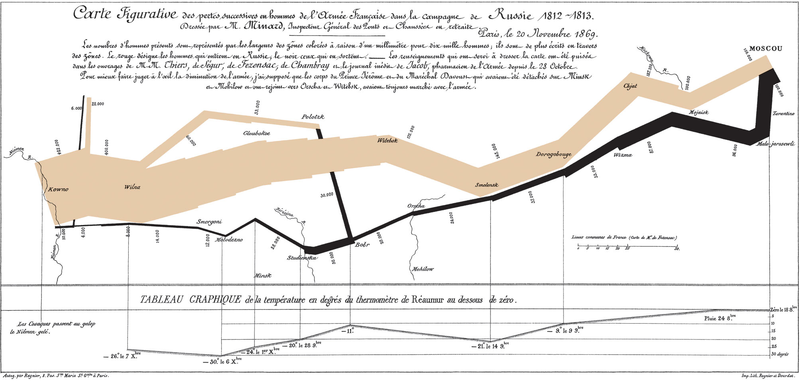
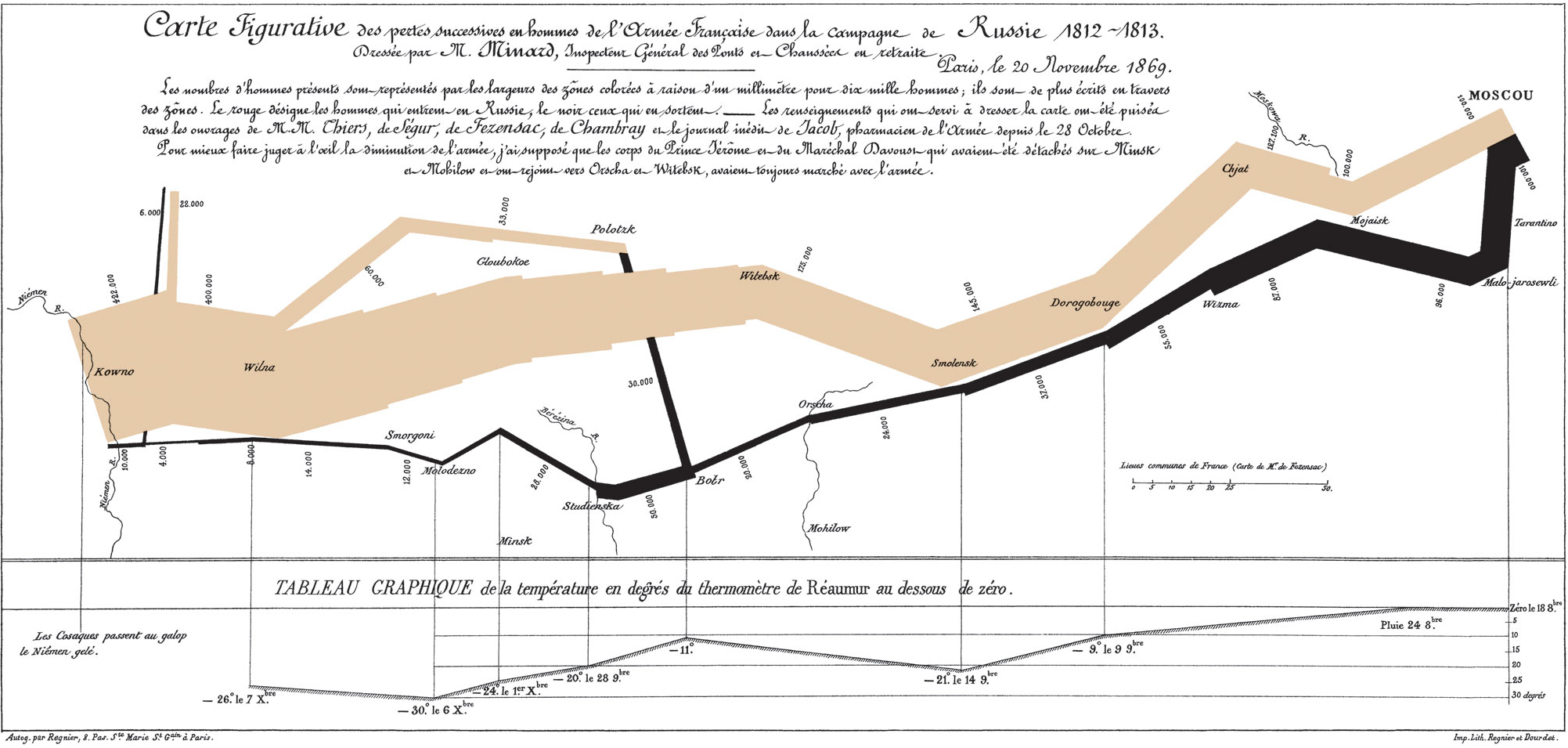
Napoleon in Russia
Drawn by Charles Minard (1869), the thickness of the lines indicates the size of Napoleon's army on his way to Moscow (1812-1813). Quite macabre, but it is a beautiful graph anyway.
Monday, August 31, 2009
Thursday, August 13, 2009
Wednesday, August 12, 2009
Salsa Dancing into the Social Sciences: Research in an Age of Info-glut
Following Tyler Cowen's suggestion, I bought Salsa Dancing into the Social Sciences: Research in an Age of Info-glut at Amazon. When it arrived, I sadly realized that it had no tables, graphs or equation and it was full of references to Foucault.
To my own suprise, I loved the book. It is an amazing guide to serious qualitative research in the social sciences and Kristin Luker is a terrific writer. Strongly recommended.
Tuesday, August 11, 2009
Monday, August 10, 2009
Wednesday, August 5, 2009
Do not complain when you are stuck on an airport
In 1850:
- The cost of a coast to coast trip in the USA was around US$200 (about US$ 5000 in 2008 dollars), around half of the income of an unskilled worker. The trip took between 4 and 6 months. (On the other hand, a ticket from Sweden to New York was around US$ 17-25 and took less than a couple of months.)
Source: Clay, Karen e Jones, Randall Jones. Migration to Riches from the California Gold Rush. The Journal of Economic History, v.68, n.4, Dec 2008, p. 997-1027
- The cost of a coast to coast trip in the USA was around US$200 (about US$ 5000 in 2008 dollars), around half of the income of an unskilled worker. The trip took between 4 and 6 months. (On the other hand, a ticket from Sweden to New York was around US$ 17-25 and took less than a couple of months.)
Source: Clay, Karen e Jones, Randall Jones. Migration to Riches from the California Gold Rush. The Journal of Economic History, v.68, n.4, Dec 2008, p. 997-1027
Saturday, July 18, 2009
On vacation
A two-week break. I am going to be off-line, unplugged and disconnected until the end of July.
All the best!
Wednesday, July 15, 2009
French Revolution and Napoleon as natural experiments
Acemoglu, Cantoni, Johnson e Robinson state that the regions invaded by the French grew faster than other areas . ( Maybe an Olsonian mechanism could explain this fact...)
BTW, bon 14 juillet à tous!
BTW, bon 14 juillet à tous!
Monday, July 13, 2009
Sunday, July 12, 2009
Jeffrey Williamson talks
The scholar talks about the crucial themes on economic history: long term growth, globalization(s), divergence/convergence, immigration, and everything else.
Friday, July 3, 2009
The José Mindlin Library on Brazil
Tons of rare books and manuscripts are available on-line. The site is in Portuguese, but there are several documents in English, French and German.
Subscribe to:
Posts (Atom)