Thursday, January 14, 2010
Chinese Amazon.com
Google toolbar in firefox allows you to browse Chinese Amazon . Take care. The "Flirting apparatus" section is NSFW.

Sunday, January 10, 2010
Saturday, January 9, 2010
Friday, January 8, 2010
Two quotes that I will repeat as mine
"I started this blog because my wife wanted me to stop telling her all my ideas, and this was a cheap way to communicate with all my friends in academia." (So did I!)From the interview of Matthew Kahn's, the urban and environmental economist (via Marginal Revolution).
"I think it's important to know what you don't know. When you know that you don't know something, the answer is to experiment!"
(BTW, he is married to Dora Costa, the brilliant economic historian.)
Wednesday, January 6, 2010
Monday, January 4, 2010
Friday, January 1, 2010
Thursday, December 31, 2009

Sunday, December 27, 2009

Thursday, December 24, 2009
4 Nobel Prize winners in São Paulo
...and several top researchers:Second Brazilian Workshop of the Game Theory Society. (Thanks, Vanessa Nadalin)
Tuesday, December 22, 2009
Saturday, December 19, 2009
Wednesday, December 16, 2009
New season of More or Less
My favorite rádio show presented by Tim Harford. Download it now because each episode is available for just one week.
Hyperinflation in ZImbabwe
The Zimbabwean dollar has gone, but this picture depicts its inglorious end.

Via boingboing.
UPDATE: Thomas Kang is a trillionaire!
Via boingboing.
UPDATE: Thomas Kang is a trillionaire!
Tuesday, December 15, 2009
Malaria in 1870 USA
Darker shades represent places with a higher share of malaria victims among the dead. It could reach almost 18% in some counties.
Saturday, December 12, 2009
Science is interesting
NYT Year in Ideas. There are a whole bunch of amazing things. From studies on racial discrimination on football to ultimatum game played by drunks.
(If you disagree with the title of the post , then....)
Tuesday, December 8, 2009
Off-topic
- Google street view: Pompeii. (via Brad Delong)
- Great firefox plug-in to organize trips.
- Bollywood goes to China. Weird, but fun. Torrent file here. This week I am going to watch Dhoom 2, a Brazilian-Bollywood adventure.
Wednesday, November 18, 2009
Tuesday, November 17, 2009
All the flights of the world
24 hours in 72 seconds. (I can not even guess the size of the W matrix!)
Ideas that I am not going to carry out: do the same thing with Eltis data on slave trade.
Ideas that I am not going to carry out: do the same thing with Eltis data on slave trade.
Monday, November 16, 2009
Sunday, November 8, 2009
Friday, November 6, 2009
The Economist's New Clothes
This BBC 4 radio show about the 2009 crisis has interviews with Quah, Scholes e Thaler. (The presenter is quite simplistic, but it is a nice show anyway)
Friday, October 30, 2009
Mainstream Plurocracy
I came across the expression "mainstream plurodoxy" while reading this paper by David Colander (hat tip Shikida). I think it quite a neat way to describe modern economics:
By plurodoxy, I mean a mainstream that has no orthodoxy, neoclassical or other. It is a mainstream composed of many different competing beliefs and research programs...I think that the concept is a "sequel" of his paper 2000 paper "The Death of Neoclassical Economics"
Today, the problem facing all heterodox groups, Austrians included, is that much of what they were fighting against no longer exists, if it ever did exist. Any orthodoxy that may have existed back in the 1970s has been replaced by a mainstream plurocracy.
Thursday, October 29, 2009
Wednesday, October 28, 2009
Saturday, October 24, 2009
Friday, October 23, 2009
Thursday, October 22, 2009
The role of rats and beer in Economic History
Economic History Blog is an excellent blog and also entertaining. Recently the author came across rat furs (!?!?!?!!?) exports from Manhattan to the Netherlands. In another post, he argues that beer may have caused the Industrial Revolution.
G R Elton - The Practice of History
It is an great book on the theory and practice of History. Geoffrey Elton is such an amazing writer, it almost reads like poetry. The first paragraph:
"The future is dark, the present burdensome; only the past, dead and finished, bears contemplation. Those who look upon it have survived it: they are its product and its victors. No wonder, therefore, that men concern themselves with history."
Tuesday, October 20, 2009
Netlogo
My friend Bernardo Furtado convinced me that Netlogo is pretty cool. He showed me a bunch of impressive simulations, but one really got me: Von Thünen model.
Links
Video: Robert Allen:Why was the Industrial Revolution British?. (via Brad Delong)
Gapminder now holds data on food production and regional inequality. (via Marginal Revolution)
Anti-capitalist soviet posters were amazing! (via BoingBoing)
Art ?? (via BoingBoing)
Gapminder now holds data on food production and regional inequality. (via Marginal Revolution)
Anti-capitalist soviet posters were amazing! (via BoingBoing)
Art ?? (via BoingBoing)
Tuesday, October 13, 2009
Monday, October 12, 2009
Friday, October 9, 2009
Thursday, October 8, 2009
Tax on innumeracy is well spent
Britain's National Lotery will help Bletchley Park. Cory Doctorow points the irony : innumerates fund the preservation of the memory of the geniuses of the past.
Tuesday, September 29, 2009
Economics is easy
Law is hard. Amartya Sen poses the dilemma:
Suppose three children—Anne, Bob, and Carla—quarrel over a flute. Anne says it's hers because she's the only one who knows how to play it. Bob counters that he's the poorest and has no toys, so the flute would at least give him something to play with. Carla reminds Anne and Bob that she built the darn thing, and no sooner did she finish it than the other two started trying to take it away.Who should get the flute? Tough, isn't it? I guess that I am going to stick with Economic History and Regional Economics.
"Lazy Japanese and Thieving Germans" Ha-Joon Chang
I do not agree with Ha Joon Chang's (conspiracy) theory on the relationship between protectionism and development. But now he got it right: culture does not precule long term development.
HT Brad Delong.
HT Brad Delong.
Wednesday, September 23, 2009
Monday, September 21, 2009
Wednesday, September 16, 2009
Cliometrica
A new number of the French journal. I have not read it yet (as usual), but the titles of the papers called my attention (e.g. "Fallacious convergence? Williamson’s real wage comparisons under scrutiny")
Tuesday, September 15, 2009
More or less
Is there any other radio show where you can listen to Hal Varian (talking about statistics) and Andrew Gelman ("Do beautiful parents have more daughters?")?
Now the full archives of the show are available on-line!
Now the full archives of the show are available on-line!
Tuesday, September 8, 2009
I envy Ed Glaeser
I confess. In one year he has posted ten new (and excellent, I am sure) papers in his web page! Besides, he is a great writer. Check out his review of the book on the quarrel between Robert Moses and Jane Jacobs.
Saturday, September 5, 2009
Friday, September 4, 2009
Cofffe and Sugar
Hans-Joachim Voth and Jonathan Hersh estimate that the introduction of coffee and sugar led to a 10% increase in welfare. They say that the stagnant wages before 1800 is a distortion caused by the exclusion of these goods from price indexes. Their method of estimation seems very interesting. Two phrases:
"Half of all spending was on beer and bread, and fully three-quarters of all calories came from these two sources alone."
"The reason why seemingly mundane goods like sugar, coffee and tea made a big difference to living standards is that life was not just “nasty, brutish, and short” at their time of introduction – it was also (in culinary terms) grey, boring, and bland."
Wednesday, September 2, 2009

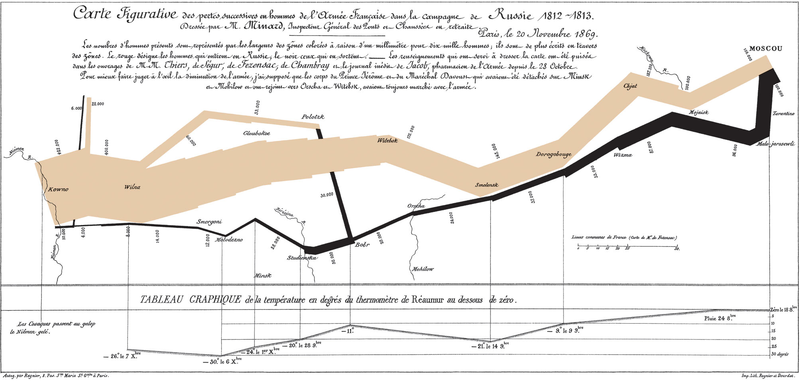
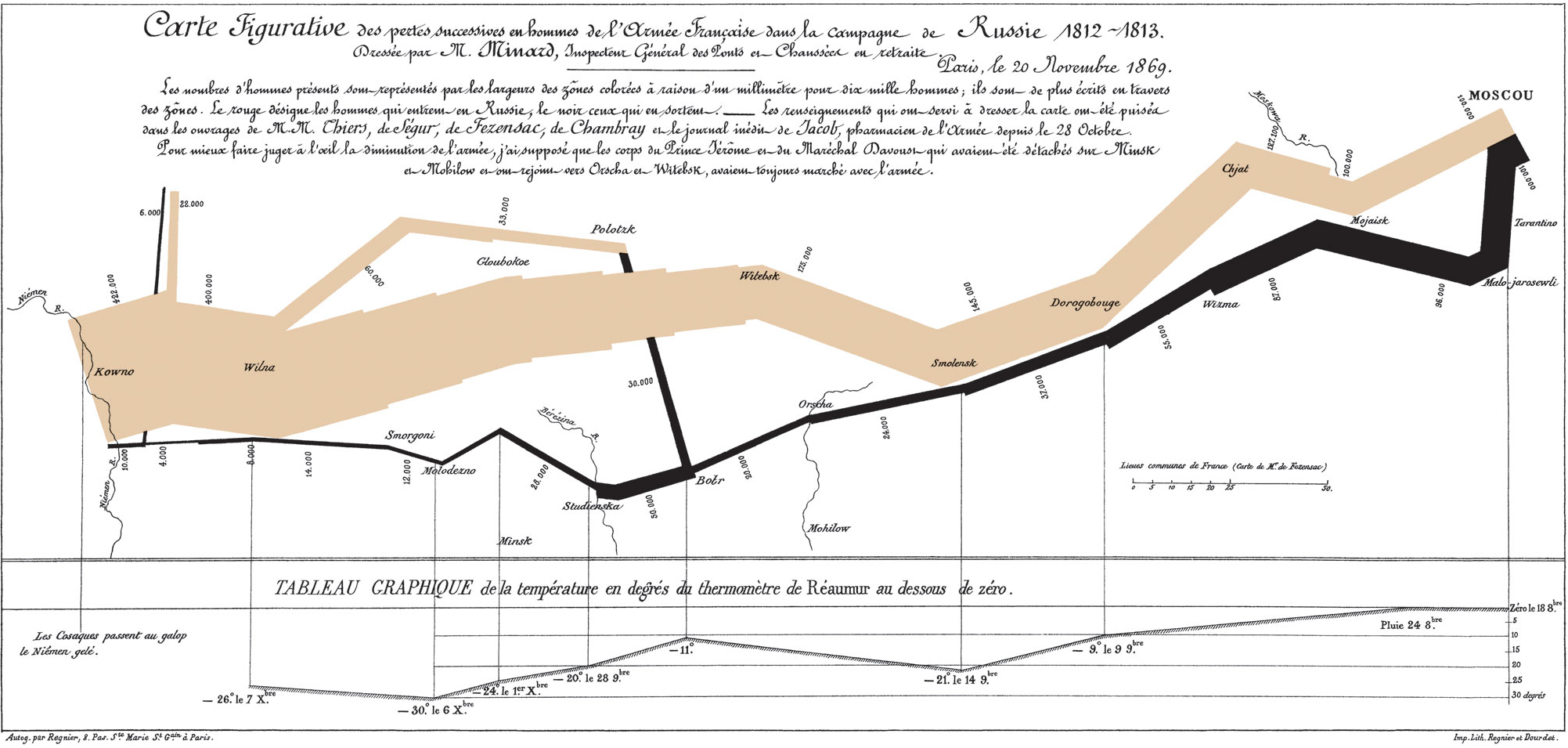
Napoleon in Russia
Drawn by Charles Minard (1869), the thickness of the lines indicates the size of Napoleon's army on his way to Moscow (1812-1813). Quite macabre, but it is a beautiful graph anyway.
Monday, August 31, 2009
Thursday, August 13, 2009
Wednesday, August 12, 2009
Salsa Dancing into the Social Sciences: Research in an Age of Info-glut
Following Tyler Cowen's suggestion, I bought Salsa Dancing into the Social Sciences: Research in an Age of Info-glut at Amazon. When it arrived, I sadly realized that it had no tables, graphs or equation and it was full of references to Foucault.
To my own suprise, I loved the book. It is an amazing guide to serious qualitative research in the social sciences and Kristin Luker is a terrific writer. Strongly recommended.
Tuesday, August 11, 2009
Monday, August 10, 2009
Wednesday, August 5, 2009
Do not complain when you are stuck on an airport
In 1850:
- The cost of a coast to coast trip in the USA was around US$200 (about US$ 5000 in 2008 dollars), around half of the income of an unskilled worker. The trip took between 4 and 6 months. (On the other hand, a ticket from Sweden to New York was around US$ 17-25 and took less than a couple of months.)
Source: Clay, Karen e Jones, Randall Jones. Migration to Riches from the California Gold Rush. The Journal of Economic History, v.68, n.4, Dec 2008, p. 997-1027
- The cost of a coast to coast trip in the USA was around US$200 (about US$ 5000 in 2008 dollars), around half of the income of an unskilled worker. The trip took between 4 and 6 months. (On the other hand, a ticket from Sweden to New York was around US$ 17-25 and took less than a couple of months.)
Source: Clay, Karen e Jones, Randall Jones. Migration to Riches from the California Gold Rush. The Journal of Economic History, v.68, n.4, Dec 2008, p. 997-1027
Saturday, July 18, 2009
On vacation
A two-week break. I am going to be off-line, unplugged and disconnected until the end of July.
All the best!
Wednesday, July 15, 2009
French Revolution and Napoleon as natural experiments
Acemoglu, Cantoni, Johnson e Robinson state that the regions invaded by the French grew faster than other areas . ( Maybe an Olsonian mechanism could explain this fact...)
BTW, bon 14 juillet à tous!
BTW, bon 14 juillet à tous!
Monday, July 13, 2009
Sunday, July 12, 2009
Jeffrey Williamson talks
The scholar talks about the crucial themes on economic history: long term growth, globalization(s), divergence/convergence, immigration, and everything else.
Friday, July 3, 2009
The José Mindlin Library on Brazil
Tons of rare books and manuscripts are available on-line. The site is in Portuguese, but there are several documents in English, French and German.
Monday, June 22, 2009
Internet is for Porn
Yes, it is true. But you can also watch the LSE lectures of Krugman, Bernanke, Quah, Richard Thaler, Paul Collier...
Monday, June 8, 2009
Cooking
No, it was not the division of labour that made us.
Cooked food, by contrast, is easier to digest, gives you more energy, and
takes no time to eat. Cooking also kills bacteria and renders many natural
poisons inactive. So the simple expedient of heating food gave us access to many
more safe calories every day, which was a survival jackpot. Once we started to
eat soft, cooked food, our jaws and teeth were no longer required to munch
ceaselessly, and they became smaller and more delicate. That is why we don't
look like apes anymore. Similarly, the more cooked food we ate, the less
industrial-strength digestion we had to do, and the smaller our guts became. In
the same way that our bodies evolved to better walk on two legs, our bellies
changed to better handle well-done over rare.
Monday, June 1, 2009

Software Tips
- I gave up Remember the Milk and moved to Google Tasks (5 additional ways to access it);
- Quantum GIS, the open source alternative to ArcView.
- Go-oo, an Open Office upgrade. HT Renato Colistete. (If you use Ubuntu there is no need to upgrade.)
- Quantum GIS, the open source alternative to ArcView.
- Go-oo, an Open Office upgrade. HT Renato Colistete. (If you use Ubuntu there is no need to upgrade.)
Sunday, May 31, 2009
Industrial Revolution. Why Europe and not China? Why Britain?
Two new explanations:
-Hans-Joachim Voth (et alii) says that the reason lies in the emergence of the European Marriage Pattern . (BTW, Voth creates amazing papers' titles)
- Robert Allen asserts that trade created the conditions for the British Industrial Revolution: high wages and cheap energy. (The book with the full story is here. The Economist reviews it here).
-Hans-Joachim Voth (et alii) says that the reason lies in the emergence of the European Marriage Pattern . (BTW, Voth creates amazing papers' titles)
- Robert Allen asserts that trade created the conditions for the British Industrial Revolution: high wages and cheap energy. (The book with the full story is here. The Economist reviews it here).
Tuesday, May 26, 2009
European Slaves in Africa
I know that human trafficking was quite common during the poor, nasty, brutish, and long human history. However, this really have surprised me:
"According to one estimate, 7,000 English people were abducted between 1622-1644, many of them ships' crews and passengers. But the corsairs also landed on unguarded beaches, often at night, to snatch the unwary.It seems that one million Europeans (an overestimation, some may say) were slaved by North African pirates between 1530 and 1780. More about the subject.
Almost all the inhabitants of the village of Baltimore, in Ireland, were captured in 1631, and there were other raids in Devon and Cornwall."
Monday, May 25, 2009
Google Maps + Time Machine
Be prepared to spend more than 8 hours just in Hypercities.
(Zephyr Frank and Sidney Chalhoub were (are?) working on something similar for Rio de Janeiro)
Via Wired.
(Zephyr Frank and Sidney Chalhoub were (are?) working on something similar for Rio de Janeiro)
Via Wired.
Sunday, May 24, 2009
Consumer surplus
To whom it may concern: atemoya (2 USD/kg in Brazil) generates the highest consumer surplus possible (at least for me).
UPDATE: The price fell to 1,5 USD/kg!!!
UPDATE: The price fell to 1,5 USD/kg!!!
Thursday, May 21, 2009
Jorge Luís Borges reads "Del rigor en la ciencia" (On Exactitude in Science) (Via Boing Boing)
In that Empire, the Art of Cartography attained such Perfection that the map of a single Province occupied the entirety of a City, and the map of the Empire, the entirety of a Province. In time, those Unconscionable Maps no longer satisfied, and the Cartographers Guilds struck a Map of the Empire whose size was that of the Empire, and which coincided point for point with it. The following Generations, who were not so fond of the Study of Cartography as their Forebears had been, saw that that vast Map was Useless, and not without some Pitilessness was it, that they delivered it up to the Inclemencies of Sun and Winters. In the Deserts of the West, still today, there are Tattered Ruins of that Map, inhabited by Animals and Beggars; in all the Land there is no other Relic of the Disciplines of Geography.Borges' short stories give lessons in Methodology . "El rigor..." is a perfect response when somebody criticizes a model for being an abstraction of reality. "Funes, the Memorious" explains why it is dangerous to consider all details of reality or history. Abstraction is a necessity.
Tuesday, May 19, 2009
Rodrik X Easterly on Industrial Policy and Steady Growth
William Easterly nailed it!
HT Brad DeLong.
"So here is Dani Rodrik on success and industrial policy: “the countries that have produced steady, long-term growth during the last six decades are those that relied on a different strategy: promoting diversification into manufactured … goods” (cited in Economist’s View).
So Dani concludes, “What matters [for growth in developing countries] is their output of modern industrial goods” and that developing countries will have to get busy with “real industrial policies.” Finally, “external policy actors (for example, the World Trade Organization) will have to be more tolerant of these policies.”
Unfortunately, Dani is also REVERSING CONDITIONAL PROBABILITIES. Dani’s evidence is based on what he believes is the high probability that IF you have had steady growth for six decades, THEN you had industrial policy. This is interesting, but this is not the right probability in deciding whether to choose industrial policy, which is “IF you have industrial policy, THEN what is your chance of steady growth for six decades?”"
HT Brad DeLong.
"It is the economy, companheiro!": an empirical analysis of Lula's re-election based on municipal data
by Araújo Jr, Carraro, Damé, Shikida and me in the Economics Bulletin
This paper discusses the reasons that led to the Lula's 2006 re-election. Spatial analysis methods revealed that,contrary to 2002, the President had more votes in less developed municipalities of Brazil. The econometric results cast doubt on the analyses that attribute to Bolsa Família Programme total responsibility for the re-election. Lula''s electoral success results from changes in the labor market, low inflation and an export boom that have reduced inequality and
improved the real wages of the Brazilian poor.
Monday, May 18, 2009
GM, Ford , and Chrysler should not loose hope
Honda makes mistakes after all. (and/or Jeremy Clarkson is a comedy genius)
via Arts and Letters Daily
via Arts and Letters Daily
Thursday, May 14, 2009
Unfair competition
When people say "unfair competition" they usually mean a) "I not understand comparative advantages"; b) "I have vested interest in protectionism. However in this situation "unfair competition" is an understatement.
Wednesday, May 13, 2009
Economist should be despised
Hayek said that Marshall said:
(Strangely I could not find the exact reference. Maybe Hayek was just like Keynes, who had the habit of making up quotations.)
‘Students of social science, must fear popular approval: Evil is with
them when all men speak well of them’.
(Strangely I could not find the exact reference. Maybe Hayek was just like Keynes, who had the habit of making up quotations.)
Sunday, May 10, 2009

Saturday, May 9, 2009
How useful is anthropometric history?
...Some reflections on Paul Hohenberg’s recent presidential address to the American Economic History Association by John Komlos:
Obviously I am on Professor Komlos' side. (In fact, I think that Economic History should not try to be useful in any sense. Searching for the truth (or Truth or "truth", you choose) is a mission tough enough.)
"In his recent presidential address to the American Economic History Association, Paul Hohenberg argued that anthropometric history does not meet his criteria for useful research in the field of economic history. He considers research useful if (a) it “helps shape one of our underlying disciplines”; b) it contributes “to clear—even fresh—thinking about current, policy-related issues or on-going scholarly debates about the historical past"; and c) it “penetrates the fuzzy realm of identity-shaping popular discourse”. I argue briefly that only a superficial reading of the literature would lead to the conclusion that anthropometric history has not been useful."
Obviously I am on Professor Komlos' side. (In fact, I think that Economic History should not try to be useful in any sense. Searching for the truth (or Truth or "truth", you choose) is a mission tough enough.)
Parks and Recreation
Greg Daniels has created a kind of The Office set in the public sector: Parks and Recreation. It is not really funny, but it is terrific.
Friday, May 8, 2009
Is the crisis over? (II)
I hope it is. But I think it is kind of sad that one of the boldest forecasts is based just on a historic correlation. There is no model or explanatory theory.
Carlo Cipolla and Stupidity
The famous Italian historian Carlo Cipolla - quite surprisingly - stated the basic laws of stupidity.
I do believe that the root of all human suffering is stupidity, not evilness and not evil. Maybe I am wrong but this idea comforts me
Via Marginal Revolution.
I do believe that the root of all human suffering is stupidity, not evilness and not evil. Maybe I am wrong but this idea comforts me
Via Marginal Revolution.
Monday, May 4, 2009
Why Ubuntu?
In order to protect my tired madelung wrists, I gave up my dear T61 and I've bought a desktop and an ergonomic keyboard. Pretty cool machine, but it took me a couple of hours to remove the bloatware from Windows Vista.
Yesterday I installed the new Ubuntu. One hour later, everything was working perfectly, including the microsoft keyboard and the all-in-one printer. It took me 30 extra minutes to install all extra software. (In Ubuntu world you just choose the softwares that you want from a list. It downloads, installs and tracks new versions No need for going to each website and clicking "I accept" a thousand times). Awesome.
Yesterday I installed the new Ubuntu. One hour later, everything was working perfectly, including the microsoft keyboard and the all-in-one printer. It took me 30 extra minutes to install all extra software. (In Ubuntu world you just choose the softwares that you want from a list. It downloads, installs and tracks new versions No need for going to each website and clicking "I accept" a thousand times). Awesome.
Friday, May 1, 2009
Ulisses M. Ruiz de Gamboa, a cliometrician
Strangely, the works of Ulisses were flying under my radar. He's been working with historical Brazilian public finance for many years and now he and William Summerhill are uncovering "fiscal skeletons".
I met him last week and found out that, besides being technically sophisticated, he is a nice guy!
I met him last week and found out that, besides being technically sophisticated, he is a nice guy!
Wednesday, April 29, 2009
Tuesday, April 28, 2009
I'm back...
The conference was great. It was terrific to spend 3 days among economic historians. Soon I will write posts about the work of the colleagues that I met there.
Now I am back to real life. Yet no symptoms of the flu.
(By the way, the post bellow was already scheduled before the outbreak. Just plain coincidence.)
Now I am back to real life. Yet no symptoms of the flu.
(By the way, the post bellow was already scheduled before the outbreak. Just plain coincidence.)
Saturday, April 25, 2009
The Map of the Plague
Aqui. Hat tip Rafael P.
What happened in Milan? Google says that there "city officials immediately walled up houses found to have the plague, isolating the healthy in them along with the sick". Ouch.
Thursday, April 23, 2009
More or Less by Tim Harford
A new series of one my favorite radio shows. In the first show Tim Harford investigates the costs drug prohibition.
Wednesday, April 22, 2009
Latin American Economies: History and Globalization
Conference sponsored by the Center for Economic History da UCLA. I am going to LA in a few hours and I'll back on Monday. The conference papers are available for download.
Tuesday, April 21, 2009
Is the crisis over?
Nicholas Bloom forecasted the 2009 crisis (take a look at his cool graph of stock market volatility since 1880). Now he says that uncertainty is falling and recovery in on the way.
Joaquim Nabuco, British Abolitionists, and the End of Slavery in Brazil: Correspondence 1880-1905
The Institute for the Study of the Americas is pleased to invite you to the launch of
Joaquim Nabuco, British Abolitionists and the End of Slavery in Brazil
edited by Leslie Bethell and José Murilo de Carvalho
Wednesday 22 April at 4.30pm
Venue: Conference Room, Institute of Advanced Legal Studies, Charles Clore House, 17 Russell Square, London WC1B 5DR
Contact: olga.jiemenz@sas.ac.uk or 020 7862 8871
A little studied aspect of the struggle to abolish slavery in Brazil in the 1880s is the relationship established and maintained between Joaquim Nabuco, the leading Brazilian abolitionist, and the British and Foreign Anti-Slavery Society in London. The correspondence between Nabuco and Charles Harris Allen, Secretary of the Anti-Slavery Society, and other British abolitionists throughout the decade and beyond reveals a partnership consciously sought by Nabuco in order to internationalise the struggle. These letters provide a unique insight into the evolution of Nabuco's thinking on both slavery and abolition and at the same time a running commentary on the slow and (at least until 1887) uncertain progress of the abolitionist cause in Brazil.
Leslie Bethell is Emeritus Professor of Latin American History at the University of London, Emeritus Fellow of St Antony's College, Oxford, Senior Research Fellow at the Centro de Pesquisa e Documentação de História Contemporânea do Brasil, Fundação Getúlio Vargas, Rio de Janeiro and a member of the Brazilian Academy of Sciences. He is an Honorary Research Fellow of the Institute for the Study of the Americas.
José Murilo de Carvalho is Professor of History at the Federal University of Rio de Janeiro and a member of the Brazilian Academy of Letters and the Brazilian Academy of Sciences.
Compre na Amazon aqui (US$30).
Monday, April 20, 2009
The bank that had Christopher Columbus account
Banco di San Giorgio was the creator of:
- Government bonds;
- Double-entry book-keeping;
among many other things....
(a Giuseppe Felloni's bilingual book about the bank is available here for free)
- Government bonds;
- Double-entry book-keeping;
among many other things....
(a Giuseppe Felloni's bilingual book about the bank is available here for free)
Friday, April 17, 2009
Markets in Everything ... maybe not
"Somewhere out there is a company that has actually figured out how to enlarge penises, and it is helpless to reach out potential consumers"
xkcd
Tuesday, April 14, 2009
Cambridge Centre for Quantitative Economic History
Maybe I've already blogged about this group, but here it goes.
By the way, I finally updated the blogroll.
By the way, I finally updated the blogroll.
Monday, April 13, 2009
Useful links for a world in crisis
Sourcetone: a music therapy on-line radio. (listeners outside the US face limitations);
Taxi fare calculator: World and Brazil. (HT: Ricardo Freire);
Ubuntu Pocket Guide;
Quick R: R for stata, spss and SAS users;
Vuze: by far the best torrent client for Windows and Linux;
Monty Python - The Movies (6 Disc Box Set) for 11 GBP (16 USD)!
Taxi fare calculator: World and Brazil. (HT: Ricardo Freire);
Ubuntu Pocket Guide;
Quick R: R for stata, spss and SAS users;
Vuze: by far the best torrent client for Windows and Linux;
Monty Python - The Movies (6 Disc Box Set) for 11 GBP (16 USD)!
Sunday, April 12, 2009
The Effect of Prayer on God's Attitude Toward Mankind
Monday, April 6, 2009
Great Depression versus 2008 Crisis
Eichengreen and O'Rourke bring good and bad news:
(The graphs are awesome)
To summarize: the world is currently undergoing an economic shock every bit as big as the Great Depression shock of 1929-30. Looking just at the US leads one to overlook how alarming the current situation is even in comparison with 1929-30.
The good news, of course, is that the policy response is very different. The question now is whether that policy response will work. For the answer, stay tuned for our next column.
(The graphs are awesome)
Sunday, April 5, 2009
Economics 2.0 by Häring and Storbeck
The book aims the non-specialist curious about the last decade of results from the Economics research (mainly empirical). It covers some topics that other economics-for-the-masses-books also deal: Behavioral Economics, Economics of Happiness, Discrimination, Game Theory. Moreover, it is has chapters on: Anthropometric History, History of Globalization, Efficient Market Hypothesis, Economics of Sports and even a chapter on the subprime crisis.
Highly recommended for non-specialists and for over specialized economists drowning in pdf's an willing to have an overview of other areas.
(Disclosure: I received the book as a gift from the editors.)
Highly recommended for non-specialists and for over specialized economists drowning in pdf's an willing to have an overview of other areas.
(Disclosure: I received the book as a gift from the editors.)
Saturday, April 4, 2009
Wednesday, April 1, 2009
It is really strange world...
when I just can not notice anymore what it is April fool's day or true science.
Subscribe to:
Comments (Atom)