The event will cost about USD 15 billion to Brazilian taxpayers. Proposal: transfer the World Cup to England. Half of the money saved would be shared among 100,000 winners of a national lottery. Each would receive USD 75,000 and would receive the patriotic mission of cheering for Brazil in Wembley.
The other half of the money would be spent in extravagant stuff, such as health and education.
Tuesday, June 21, 2011

Monday, May 30, 2011

Sunday, May 29, 2011
Links
-Natural experiments that should not be replicated :The long-run impact of bombing Vietnam; (HT Rafael);
- Sometimes culture matters: Anti-Semitic during the Black Death were most likely to acts of violence against Jews in interwar Germany);
- Journals: advices to editors and authors (Via Marginal Revolution. BTW, how come someone disagrees with the fact that MR is the best Economics blog ?!?!?);
- The Economist on the Brazilian North-east . Accurate facts, but the tone is a little bit too optimistic.
- Sometimes culture matters: Anti-Semitic during the Black Death were most likely to acts of violence against Jews in interwar Germany);
- Journals: advices to editors and authors (Via Marginal Revolution. BTW, how come someone disagrees with the fact that MR is the best Economics blog ?!?!?);
- The Economist on the Brazilian North-east . Accurate facts, but the tone is a little bit too optimistic.
Friday, May 20, 2011
Wednesday, May 18, 2011
Monday, May 16, 2011

Cliometrics and regional economics news
- 5tas Jornadas Uruguayas de Historia Económica;
- 58th Annual North American Meetings of the Regional Science Association International, 2011.
- Número novo da Cliometrica!
(I would like to apologize to my 1,232,543 readers. I've been too busy to post in the last couple of weeks).
Saturday, April 23, 2011
Saturday, April 16, 2011
The Surface of Consumption
This is a photograph of a model that Prof. Irving Fisher used in his classes. Beautiful.

I promise that I will stop complaining when I can not get the right colors in my scatterplots.
Source: Frisch, R. 1932. New methods of measuring marginal utility. Tubingen: J. C. B. Mohr. p. 16.

I promise that I will stop complaining when I can not get the right colors in my scatterplots.
Source: Frisch, R. 1932. New methods of measuring marginal utility. Tubingen: J. C. B. Mohr. p. 16.
Friday, April 15, 2011
Chinese Ghost Cities?
Some say they are dead. Other people say that this is not exactly the case.
All right, I volunteer to fly to China and check it myself . Please, cable the money.
All right, I volunteer to fly to China and check it myself . Please, cable the money.
Tuesday, April 5, 2011
How unequal is Brazil?
A lot. The table bellow shows monthly family income per capita by percentile. (Yes, it includes Bolsa Família, the cash based transfer program that reaches 11 million families).
1,61 BRL=1 USD (the current exchange rate).
| Percentile | R$ | US$ |
| 5 | 53 | 33 |
| 10 | 100 | 62 |
| 50 | 375 | 233 |
| 90 | 1300 | 807 |
| 95 | 2000 | 1242 |
| 99 | 4650 | 2888 |
| Source: PNAD (IBGE, 2009) | ||
1,61 BRL=1 USD (the current exchange rate).
Friday, April 1, 2011
Thursday, March 31, 2011
Brasília for Tourists
Brasília is not as human unfriendly as it looks for the first time visitor. I guess that the best thing to do is to take a walk on its Superquadras, like SQS 308, and feel how it is to live here. The main tourist attractions are just there: Congresso Nacional, Palácio Itamaraty, Catedral and so on... Catetinho, the temporary home of the president during the construction of the capital, is far from the center and holds a small exhibition about the city. Interesting, but it appeals only to the Architecture/Brazilian history fans. Skip it if you do not have time to spare.
Brasília is not a place for foodies, but here is my list of restaurants
Brasília is not a place for foodies, but here is my list of restaurants
- Ethnic or International: Despite all the embassies, the demographics is pretty homogeneous, so ethnic and international restaurants - in general - should be avoided. Palace Long Fu(Chinese) at Academia de Tênis is OK. Pretty much the same thing that you can find at an average restaurant in China. Servus is an Austrian restaurant in the countryside. The restaurant, almost hidden, is located about 40 minute away from the center of Brasilia near Tororó Falls. The owner speaks English and can give instructions. Opens on Saturdays and Sundays. Reservations are strongly recommended (Phone 3339-6180).
- Brazilian Barbecue: Porcão and Fogo de Chão. The branches in Brasília offer the same top quality as everywhere else.
- Regional (Northeast) food : Mangai is the one that everybody knows and recommends. It is pretty good, but my choice is Macambira (SCRLN 714 bloco F loja 22). The place is tiny, not well located and opens just for lunch. It is not as good as Mocotó (in São Paulo), but the idea is quite the same.Tia Zélia, Lula's favourite (people say), is just fine (Opens for lunch on Mondays to Fridays).
- I've never been to Aquavit (Scandinavian). The prices are comparable to two-star restaurants in France. I will wait for the next Brazilian currency crisis to visit the place.:-)
- Places to avoid: Beirute for its bad food, and Zuu , overpriced.
Saturday, March 26, 2011
Aelita: the Queen of Mars (1924) or Chavez was (almost) right
In fact, Socialism saved the Martian civilization! The DVD says:
Youtube has the movie in 9 parts.
Russia's first big budget science fiction spectacular. "Aelita, the Queen of Mars" is a fantastic adventure about Los, an engineer living in Moscow who dreams of Aelita and builds a spaceship to take him to her. They fall in love, but Los soon finds himself embroiled in a proletarian uprising to establish a Martian Union of Soviet Socialist Republics!
Youtube has the movie in 9 parts.
Wednesday, March 16, 2011
The flood in South Saint Lawrence (Brazil)
Even worse than having your hometown destroyed by a flood is having your city destroyed by a flood while everybody is looking to the other side of the world. This is what happened to my former student and friend Martin Brauch and his São Lourenço do Sul, in southern Brazil.
He has created a website for those willing to help.
Wednesday, March 9, 2011
Happy Economics Day!
The Wealth of the Nations was published on 03/09/1776.
(Hopefully, there will be the day when a Google doodle will celebrate this day!)
(Hopefully, there will be the day when a Google doodle will celebrate this day!)
Wednesday, February 16, 2011
Interview with Ed Glaeser
Here. Excerpt:
Update (via Mankiw's blog):
"The great urbanist Jane Jacobs was correct about so much in cities, but she got housing prices wrong. She noted that old housing was cheaper than new housing, and so she thought that restricting new development could keep prices down. That’s not how supply and demand works. Abundant supply is the only way to reduce prices in really high-demand areas."
Update (via Mankiw's blog):
Tuesday, February 15, 2011
Hackerville, Romania
Marshallian externalities sometimes have a dark side: a cluster of cybercrooks:
“To the extent that some expertise is required, friends and family members of the original entrepreneurs are more likely to have access to those resources than would-be criminals in an isolated location,” says Michael Macy, a Cornell University sociologist who studies social networks. “There may also be local political resources that provide a degree of protection.”
Online thievery as a ticket to the good life spread from the early pioneers to scores of young men, infecting Râmnicu Vâlcea’s social fabric. The con artists were the ones with the nice cars and fancy clothes—the local kids made good. And just as in Silicon Valley, the clustering of operations in one place made it that much easier for more to get started. “There’s a high concentration of people offering the kinds of services you need to build a criminal scheme,” says Gary Dickson, an FBI agent who worked in Bucharest from 2005 to 2010. “If your specialty is auction frauds, you can find a money pick-up guy. If you’re a money pick-up guy, you can find a buyer for your services.”
Friday, February 11, 2011
Pre-industrial Inequality por Milanovic, Lindert, and Williamson
About 4 years ago Jeffery Williamson gave this amazing paper at a Economic History Association meeting. Now it wil be published in the Economic Journal:
Abstract:
Is inequality largely the result of the Industrial Revolution? Or, were pre-industrial incomes as unequal as they are today? This article infers inequality across individuals within each of the 28 pre-industrial societies, for which data were available, using what are known as social tables. It applies two new concepts: the inequality possibility frontier and the inequality extraction ratio. They compare the observed income inequality to the maximum feasible inequality that, at a given level of income, might have been ‘extracted’ by those in power. The results give new insights into the connection between inequality and economic development in the very long run.IMHO, the concept of inequality possibility frontier is brilliant and relevant for historians and development economists.
Thursday, February 10, 2011
Ronald Coase Institute - São Paulo Workshop on Institutional Analysis
As an alumnus of the Coase Institute, I strongly recommend the workshop. The deadline is February 15 and the organizers offer fellowships "to cover tuition, meals, and housing if these costs are a difficulty."
Wednesday, February 9, 2011
Tuesday, February 1, 2011
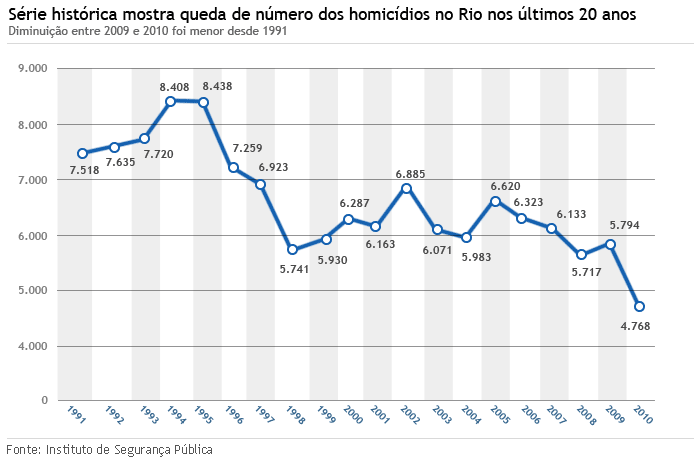
Rio de Janerio murder rate shows a sharp fall
UPDATE: There are strong signs that the governmet has applied "creative accouting" methods in their numbers. Sorry for misleading you.
30 homicides per 100,000 is not a rate to be proud of. Nevertheless, things are getting better in Rio (and in São Paulo as well). I am not following the debate, but possible causes are: demographics, rising incarceration rates, new police practices, and falling inequality and unemployment.
The graph bellow shows the absolute number of homicides since 1991:

(Source, in Portuguese)
30 homicides per 100,000 is not a rate to be proud of. Nevertheless, things are getting better in Rio (and in São Paulo as well). I am not following the debate, but possible causes are: demographics, rising incarceration rates, new police practices, and falling inequality and unemployment.
The graph bellow shows the absolute number of homicides since 1991:
(Source, in Portuguese)
National Historical Geographic Information System
NHGIS provides to US census data (1790-2000) and boundary shapefiles !!! The interface is "for dummies" and the website is free!
Monday, January 31, 2011
Poorest Brazilians are as poor as the world's poorest...
...and the richest Brazilians are as rich as the world's richest. Furthermore, the median Brazilian has an income close to the poorest 5% Americans.
Very cool graph (via Economix; I suggest the whole post):

The graph comes from "The Haves and the Have-Nots,” by Brancko Milanovic. (He is the coauthor (with Lindert and Williamson) of a great paper).
Very cool graph (via Economix; I suggest the whole post):

The graph comes from "The Haves and the Have-Nots,” by Brancko Milanovic. (He is the coauthor (with Lindert and Williamson) of a great paper).
Friday, January 28, 2011
China overtakes USA!!!
In 2008, the China's GDP per capita was US$6,725. This is a little bit higher than the GDP per capita of the USA... in 1928! Source: Maddison.
Friday, January 21, 2011
Happy Birthday, prof Coase!
On December 29th, we has turned 100 year old. Amazing. He is still productive and in July his new book will be available: How China Became Capitalist. Here goes a brilliant recent interview . Excerpts:
Coase's Theorem and Ricardo's Comparative Advantage are the best single ideas in Economics. Simple, non-trivial and even inteligent people find it hard to grasp. In his twenties, Coase had already proved that he was a genius. The question posed in The Nature of the Firm "Why do firms exist?" opened a whole new research program and has changed economic thought forever. The answer, almost everybody agree, is transaction costs.WN: (...) You have high hopes that the future of economics is in China. What makes you think so?
RC: It is obvious. It is the size of Chinese population. A new idea is always accepted only by a small proportion of the population. But a small proportion of the Chinese is a big number.
(...)
RC: I am now 100 years old. At my stage, life requires a constant effort. As I told you many times, do not get old. (...)
Wednesday, January 19, 2011
Spatial Econometrics Summer School - Rome 2011
Here. Instructors and presenters: Paelinck, Greene, Kelejian, Pesaran, Baltagi, Arbia and Bivand. Wow!
Sunday, January 16, 2011
“Immigration and the origins of regional inequality: Government-sponsored European migration to Southern Brazil before World War I”.
Here goes the link to the new paper written by Irineu de Carvalho Filho (IMF) and I. Comments are welcome!
(Yep... vacations are over and I am blogging again...)
Friday, December 24, 2010
Happy Holidays
Someone very important was born on a Xmas day. (Sorry, this is a repeated post.)
Inspired by my friend Shikida, here goes my gift to the my pacient and generous readers:
Inspired by my friend Shikida, here goes my gift to the my pacient and generous readers:
Tuesday, December 21, 2010
Catching-up....
Sorry for the lack of new posts. I've been very busy and last week I was in Ethiopia...
- The map of US slavery. (HT, Urban Demographics);
- Google ngram: a inflation X unemployment;
- Time was in love with the president of Brazil in 1954. (HT,"O" Anônimo);
- Inflation targeting and the crisis.
- The map of US slavery. (HT, Urban Demographics);
- Google ngram: a inflation X unemployment;
- Time was in love with the president of Brazil in 1954. (HT,"O" Anônimo);
- Inflation targeting and the crisis.
Wednesday, December 1, 2010
Tuesday, November 23, 2010
Self-promotion

They are talking about the book that contains, among many very interesting papers, the one that Shikida, Nogueról, and I have written on the stature of Brazilians.
Sunday, November 21, 2010
Links
This blog has been sleepy lately thanks to my limited time management skills. In order to keep it alive, just a few links:
- Slavery and inequality: what is the causal link?;
- R is what you need. Forbes says so. (HT, Urban Demographics);
- Republic of Letters. Please, click. (I forgot who sent me the link).
- Slavery and inequality: what is the causal link?;
- R is what you need. Forbes says so. (HT, Urban Demographics);
- Republic of Letters. Please, click. (I forgot who sent me the link).
Tuesday, November 9, 2010
MapCrunch, the most addictive site. Ever.
Here. Select "Slideshow", choose a couple of countries and enjoy. (Via BoingBoing).
Monday, November 8, 2010
Walter Isard (1919-2010)
The founder of Regional Science has passed away. Here is his obituary.
Many thanks.
Many thanks.
Monday, October 25, 2010
Commodity Lottery, XXI edition
The idea of a commodity lottery is well known among the students of Latin American economic history. It goes like that: the path of development that each country took was related to the characteristics of its main (natural resource based product) natural product exports: income elasticity and price, the possibility of linkages and global competition ... Exporting bananas or rubber is very different from exporting meat or coffee.
Well, now the argument of bad luck comes back. The great "New Economic Geographer" Gordon Hanson writes (via MR) in Why Mexico is not Rich? that the reason behind Mexico's misfortune is that its specialization pattern lies in goods similar to those of China.
Well, now the argument of bad luck comes back. The great "New Economic Geographer" Gordon Hanson writes (via MR) in Why Mexico is not Rich? that the reason behind Mexico's misfortune is that its specialization pattern lies in goods similar to those of China.
China’s size, high rate of growth, and increasing outward orientation mean that its emergence is surely changing international prices, improving the terms of trade for countries that produce its importables and deteriorating the terms of trade for countries that produce its exportables. Mexico fits squarely in the latter camp, whereas Argentina, Brazil, Chile, Colombia, and Peru fit in the former.
Wednesday, October 20, 2010
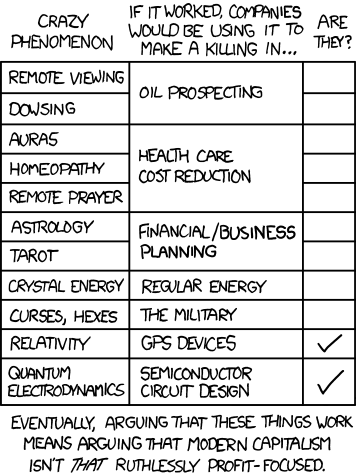
XKCD brillant as ever
 Source.
Luis Fernando Verissimo, a Brazilian writer, once proposed "voodoopuncture". Instead of going to the acupuncturist, you would be treated without leaving home. The voodoopuncturist would stick acupunture needles in the voodoo dolls of you! I add that voodoopuncture could be outsourced to Haiti and/or China. It is a win-win-win situation!
Friday, October 15, 2010
Services or Manufacturing. Which sector is the main driver of growth?
Bhagwati challenges the manufacturing fallacy. In addition, this article argues that the services sector played a major role in the revival of Indian manufacturing. (HT Escolhas e Conseqüências).
I am convinced that Colin Clark's division of the economy in three sectors is not that useful anymore. For instance, how much of a US$200 Nike shoe was produced in the services sector?
Wednesday, October 13, 2010
Regional policy in Europe
This article deals with an issue that has been on my mind for a long time: how to justify regional policies? The article is interesting, but I must say that it pays no attention to the Regional Science literature on the issue.
Sunday, October 10, 2010

Friday, October 8, 2010
"Living Standards in Latin American History: Height, Welfare, and Development, 1750-2000 "
The book -just published!- is part of the David Rockefeller Center Series on Latin American Studies, is distributed by Harvard University Press , and it is available at Amazon. One of its papers is Growth and Inequalities of Height in Brazil, 1939-1981, an anthropometrical study written by Nogueról, Shikida and myself. A previous version of the paper is available here.
Wednesday, October 6, 2010
Thursday, September 30, 2010
Monday, September 27, 2010
Gambetta and Primo Levi
I visited Diego Gambetta's page looking for his papers on the low quality of Italian academia .
With much surprise I discovered that he investigated the death of the author of If This Is a Man, one of my ten favorite books. He argues - very convincingly- that the death of Primo Levi was an accident and not a suicide . Although the two possibilities are tragic, the former seems in tune with his work and life.
With much surprise I discovered that he investigated the death of the author of If This Is a Man, one of my ten favorite books. He argues - very convincingly- that the death of Primo Levi was an accident and not a suicide . Although the two possibilities are tragic, the former seems in tune with his work and life.
Wednesday, September 22, 2010
Melissa Dell "The Persistent Effects of Peru's Minning Mita"
...Using data from the Spanish Empire and Peruvian Republic toThe paper is awesome and it is forthcoming in Econometrica.
trace channels of institutional persistence, I show that the mita's inuence has persisted through its impacts on land tenure and public goods provision. Mita districts historically had fewer large landowners and lower educational attainment. Today, they are less integrated into road networks, and their residents are substantially more likely to be subsistence farmers.
The CV of Melissa Dell is impressive: she is a graduate summa cum laude at Harvard, has a doctorate from Oxford, Ph.D. candidate at MIT, ultra marathon runner (100 km), founder of a NGO in Peru ... and she has a severe vision impairment.
Sunday, September 19, 2010
Monday, September 13, 2010
Things that you learn at an Economics conference

One presenter closed his (excellent) presentation with this cartoon. Surely I am going to copy the idea.
Friday, September 10, 2010
10th and 11th of September : 3rd International Conference Migration & Development (Paris)
Yep, I am in Paris. I've just presented the paper "How Bodo became Brazilian" written by Irineu de Carvalho Filho and myself. (I must admit that his contribution to the paper was much larger than mine). Soon you will learn more about the paper.
Thursday, September 9, 2010
Saturday, September 4, 2010
"Five Unrelated but Interesting Papers"
The program of AEA meeting is terrific. But this time it offers the best name of session ever:
Five Unrelated but Interesting Papers (??)
Presiding: ALLEN SANDERSON (University of Chicago)
Driving Under the (Cellular) Influence
SAURABH BHARGAVA (University of Chicago)
VIKRAM SINGH PATHANIA (Cornerstone Research)
Do Public Subsidies Change Private Vehicle Selections? Evidence from the U.S. Cash for Clunkers Program
EDWARD HUANG (Harvard University)
A History of Violence: The "Culture of Honor" as a Determinant of Homicide in the U.S. South
PAULINE A. GROSJEAN (University of San Francisco)
The Lion's Share: An Experimental Analysis of Polygamy in Northern Nigeria
ALISTAIR MUNRO (National Graduate Institute for Policy Studies, Japan)
ARJAN VERSCHOOR (University of East Anglia)
MARCELA TARAZONA-GOMEZ (University of East Anglia)
CECILE JACKSON (University of East Anglia)
BEREKET KEBEDE (University of East Anglia)
White Men Can't Jump, But Would You Bet on It?
DENIZ IGAN (International Monetary Fund)
MARCELO PINHEIRO (George Mason University)
JOHN SMITH (Rutgers University-Camden)
Friday, August 20, 2010
KFV reunion concert!
I've just attended the anniversary celebration of The Spatial Economy: Cities, Regions, and International Trade by Fujita, Krugman and Venables. The room was packed and professor Thisse was the chair of the session. It was the Regional Science equivalent of The Beatles reunion to celebrate "Revolver". "How did you write the book?", "Did the book made you rich? ", "What have you been doing?", "What's next?"...
They told interesting stories but there was no major revelation. It was just great to see the highest agglomeration ever of NEG founding fathers on just one stage!
PS. Weirdest thing about Sweden: there is Vitamin C at the hotel breakfast. Maybe scurvy is endemic here...
They told interesting stories but there was no major revelation. It was just great to see the highest agglomeration ever of NEG founding fathers on just one stage!
PS. Weirdest thing about Sweden: there is Vitamin C at the hotel breakfast. Maybe scurvy is endemic here...
"Education Performance: Was It All Determined 100 Years Ago? Evidence From São Paulo, Brazil"
de Carvalho Filho, Irineu and Colistete, Renato P. (2010): Education Performance: Was It All Determined 100 Years Ago? Evidence From São Paulo, Brazil. Unpublished.
"This paper deals with institutional persistence in long-term economic development. We investigate the historical record of education in one of the fastest growing and most unequal societies in the twentieth century – the state of São Paulo, Brazil. Based on historical data from an agricultural census and education statistics, we assess the role played by factors such as land concentration, immigration and type of economic activity in determining supply and demand of education during the early twentieth century, and to what degree these factors help explain current educational performance and income levels. We find a positive and enduring effect of the presence of foreign-born immigrants on the supply of public instruction, as well as a negative effect of land concentration. Immigrant farm-laborers established their own community schools, and pressured for public funding for those schools or for public schools. The effects of early adoption of public instruction can be detected more than one hundred years later in the form of better test scores and higher income per capita. These results are suggestive of an additional mechanism generating inequality across regions: the places that received immigration from countries with an established public education system benefited from an earlier adoption of the revolutionary idea of public education."
Thursday, August 19, 2010
Links
- Economy of cities;
- Temin and Eichengreen on the current crisis;
- Ray Bradbury tribute (NSFW- via BoingBoing).
- Temin and Eichengreen on the current crisis;
- Ray Bradbury tribute (NSFW- via BoingBoing).
IpeaGeo - Spatial Econometrics Software
IpeaGeo is the new spatial econometrics software developed by the IPEA team. It is free (as in free beer), user friendly and it does spatial GMM, spatial clusters and much more. Strongly recommended. Unfortunately it is only available in Portuguese.
Tuesday, August 17, 2010
Sunday, August 15, 2010
Saturday, August 14, 2010
Thursday, August 12, 2010
Another good reason for using R
Penn World Tables are available as an R package. Further news on R and econometrics are available here.
"Don’t ask a Brazilian personal questions"
"Steer clear especially of such issues as age, salary, or marriage to someone from Brazil, Argentina’s fierce rival."
I do agree that age and salary are taboo issues. But, as far as I know, we have no problem with questions on marriage.
I do agree that age and salary are taboo issues. But, as far as I know, we have no problem with questions on marriage.
Monday, August 9, 2010
Nash equilibrium by himself
 My former student Otário Damé sent this gem. According to him, his EPGE - FGV colleague, Pedro Olea, asked Nash to write the definition of the concept last week in São Paulo.
Monday, July 26, 2010
Links
- An updated version of the Big Mac index;
- Stop the press! Psychologists have discovered the decreasing marginal utility of income !
- Historical Financial Statistics. The Brazilian data comes from IPEADATA;
- Solow contra DSGE. (I do not know if he is right. But what a terrific writer he is!)
- Stop the press! Psychologists have discovered the decreasing marginal utility of income !
- Historical Financial Statistics. The Brazilian data comes from IPEADATA;
- Solow contra DSGE. (I do not know if he is right. But what a terrific writer he is!)
Sunday, July 25, 2010
World Bank Enterprise Surveys
Now you can download data on more than 100,000 firms in 123 countries.
(HT Lucas Mation)
(HT Lucas Mation)
Tuesday, July 13, 2010
New blog on Urban Demographics
Rafael Pereira,my friend and coleague at IPEA has created his own blog: Urban Demographics.
Long live to his blog!
Long live to his blog!
Wednesday, July 7, 2010
A semiologist may write a thesis on this graph
Theft risk by color of the vehicle.

The color of the bars represent the same color of the cars! Amazing!
The paper is here.

The color of the bars represent the same color of the cars! Amazing!
The paper is here.
Tuesday, July 6, 2010
Friday, June 18, 2010
Holiday
Sorry, but I've been too busy to blog. I was enjoying a pre-holiday burst of productivity.
I'll be back in two weeks.
I'll be back in two weeks.
Thursday, June 10, 2010
Hayek, the "socialist"
Has Glenn Beck actually read The Road to Serfdom? If so, I would like to know his take on this:
"There is no reason why, in a society which has reached the general level of wealth ours has, the first kind of security should not be guaranteed to all without endangering general freedom; that is: some minimum of food, shelter and clothing, sufficient to preserve health. Nor is there any reason why the state should not help to organize a comprehensive system of social insurance in providing for those common hazards of life against which few can make adequate provision" Hayek (1944)
Thursday, June 3, 2010
Markets in everything: Kaggle
Kaggle is a website to set up prediction competitions. What a great idea! Somebody uploads the data, and number crunchers all over the world will compete for the best predictions. The themes range from the mundane (Eurovision voting *) to the important (HIV progression).
(HT More or Less).
(*BTW,the unexpected winner of Eurovision 2010 is the perfect guilty pleasure song).
(HT More or Less).
(*BTW,the unexpected winner of Eurovision 2010 is the perfect guilty pleasure song).
Wednesday, June 2, 2010
Strange world: industrial tourism
The last French trend. Amazon.fr has even a section on the subject. (But I'd rather visit the 300,000 workers Foxconn unit in Shenzen.
Saturday, May 29, 2010
Books on Brazil
Tyler Cowen's post on "The culture that is Brazil" reminded me of how important it is to read foreigners account on our home countries. ("Closing banks on soccer games"? What is wrong in that?"). I do appreciate reading guide books on Brazil and I have a few notes about them:
- How to Be a Carioca: The Alternative Guide for the Tourist in Rio is a non-academic anthropology book, disguised as book guide, on contemporary Brazil. Strongly recomended for tourists, researchers (and Brazilians). But you will need a traditional guide book for the practical stuff;
- Lonely Planet Brazil : far from complete and full of mistakes. I guess that it is the first or second LP edition on Brazil, so I hope it will improve.
- Culture Shock! Brazil: A Survival Guide to Customs and Etiquette: It is a must if you intend to reside in Brazil. It is not aimed to tourists, but has lots of practical info. (I bought it because a German couple told me that the book was funny. It isn't).
Tuesday, May 25, 2010
A Jane Jacobs' neighborhood is not an equilibrium situation
I guess that this is the point of this article/review Gentrification and Its Discontents.
Saturday, May 22, 2010
Thursday, May 20, 2010
Sentences you will never read in a published paper
 If I were sincere, I'd have written half of the sentences. HT NPTO
Wednesday, May 19, 2010
I suspect...
...that physicists say the G-word just to get research funds from scientific illiterate politicians. (See the last line)
Tuesday, May 18, 2010
Taxation, Lobbies and Welfare in an Enclave Economy: Rubber in the Brazilian Amazon 1870-1910
I've met Felipe Tãmega in 2006. He was a graduate student in economic history at the LSE and Colin Lewis was his thesis supervisor. At first glance it was obvious that he was a really talented young man and a nice chap. Google led me to this very interesting paper from him (I guess it is part of his PhD thesis):
Taxation, Lobbies and Welfare in an Enclave Economy: Rubber in the Brazilian Amazon 1870-1910Now he is at the Harvard Business School. Great! Congratulations!!!
Abstract
This paper uses an enclave economy (Brazilian Amazon) to show that [export] taxes can be welfare enhancing and be used as instruments to move the economy away from the immiserizing growth path. Nonetheless, the results show that the government could have raised the Brazilian Amazon's welfare with a much higher export tax, and offers political-economic reasons why it did not.
Wednesday, May 12, 2010
Colonial Institutions, Slavery, Inequality, and Development: Evidence from São Paulo, Brazil
- Everybody is talking about the new paper from William Summerhill. Abstract:
Cool stuff.
Brazil is frequently portrayed as exhibiting persistent and structural economic inequality that is rooted in the early colonial experience, and is believed to undermine development in the long run. I construct original measures of agricultural inequality for 1905 in what is today Brazil’s largest state, using farm-level micro data for some 50,000 farms. Using these measures of inequality, along with contemporary covariates and other historical variables I assess the impact of colonial institutions, slavery, farm inequality, and political inequality on long-term development in São Paulo. The principal findings are: (1) a potentially coercive colonial institution, the aldeamento, is positively correlated with income per capita at the end of the twentieth century; (2) measures of the intensity of slavery have little if any independent impact on income in 2000; (3) farm inequality was not persistent in São Paulo at the county level over the twentieth century; (4) in both OLS and IV estimates, no negative effect can be found for 1905 inequality on long-term development; (5) political inequality in the early twentieth century, measured by the extent of the franchise, is unrelated to contemporary farm inequality, and also unrelated to long-term economic growth; and (6) the provision of local public goods in the early twentieth century, measured by local public education outlays, has a positive impact on long-term development, but was not related to contemporary economic or political inequality. Overall, neither the intensity of slavery nor the pattern of inequality had any discernable negative economic impact in the long run.
Cool stuff.
Thursday, May 6, 2010
Maps! Maps! Maps!
The Beauty of Maps:the dark side of the moon, XVI century Constantinopla, the Universe and beyond... (HT do Breno Baldrati)
Maps: Power, Plunder and Possession:
BBC docs are blocked outside the UK, so you have to find another way to download them.
Maps: Power, Plunder and Possession:
BBC docs are blocked outside the UK, so you have to find another way to download them.
Wednesday, May 5, 2010
The first law of tourism
There is an inverse relationship between the reputation of hospitality of a country and its number of tourist attractions.
Tuesday, May 4, 2010
Reboot of the European airspace
after the eruption of the I-dunno-how-to-spell-it volcano:
HT Caio Cardim.
Monday, May 3, 2010
Sunday, April 18, 2010
The funniest paper ever published in "American Economic Review"
In fact, only cliometricians (and their enemies) will laugh:
"Shatter and Filth (1975) consider "what if Fogel had never written his article" and projected that economic historians would have turned to cocaine use instead of counterfactuals."
"The new economic geography, now middle-aged" by Krugman
Krugman's talk at the Association of American Geographers. (It happened two days ago. Oh boy, I do love the internet). Highly interesting, especially when he argues that NEG is still useful to understand contemporary issues:
"... new economic geography has a kind of steampunk feel, so that the stories it tells seem more suited to the U.S. economy of 1900 than that of 2010. Well, China is an economic powerhouse, but it’s still quite poor; .., China today appears to have roughly the same level of per capita GDP as the United States at the beginning of the 20th century.(Via Brad Delong)
And guess what? Chinese economic geography is highly reminiscent of the economic geography of advanced nations circa 1900 – and it fits gratifyingly well into the new economic geography framework."
Wednesday, April 14, 2010
The Future of Regional Economics
A special issue of the Journal of Regional Science. Everybody is there: Duranton, Overman, Puga, Glaeser, Storper, Thisse...
I haven't read the papers, but the best title is: " The data avalanche is here: shouldn't we be digging?".
(HT Bruno Cruz)
I haven't read the papers, but the best title is: " The data avalanche is here: shouldn't we be digging?".
(HT Bruno Cruz)
Tuesday, April 13, 2010
The Red Water Ordeal
Nathan Nunn on the many ways to produce slaves in Guinea-Bissau
The chief of the Cassanga used the “red water ordeal” to procure slaves and their possessions. Those accused of a crime were forced to drink a poisonous red liquid. If they vomited, then they were judged to be guilty. If they did not vomit, they were deemed not guilty. However, for those that did not vomit this usually brought death by poisoning. Their possessions were then seized and their family members were sold into slavery."The Long Term Effects of Africa's Slave Trade" Quarterly Journal of Economics, Vol. 123, No. 1, February 2008, pp. 139-176.
Saturday, April 3, 2010
Wednesday, March 31, 2010
The new applied econometrics
The Credibility Revolution in Empirical Economics: How Better Research Design is Taking the Con out of Econometrics by Angrist and Pischke. Experiments and good instruments are the way to go.
Monday, March 22, 2010
Saturday, March 20, 2010
North Korea, the worst place on Earth
- The former chief of the planning and finance department of the Workers' Party was executed;
- Reality X Fantasy.
Friday, March 19, 2010
Brazilian spatial dynamics in the long term (1872–2000): “path dependency” or “reversal of fortune”?
The Journal of Geographical Systems has just published my paper . (In the same issue there is a very interesting study "From locational fundamentals to increasing returns: the spatial concentration of population in Spain, 1787–2000" )
Thursday, March 18, 2010
Tuesday, March 9, 2010
Monday, February 22, 2010
Natural Experiments of History - Diamond and Robinson (ed.)
Jared Diamond ("Guns Germs and Steel") and James Robinson ("Reversal of Fortune" with Acemoglu and Johnson) have edited the book. The table of contents is impressive!:
1. Controlled Comparison and Polynesian Cultural Evolution
Patrick V. Kirch
2. Exploding Wests: Boom and Bust in Nineteenth-Century Settler Societies
James Belich
3. Politics, Banking, and Economic Development: Evidence from New World Economies
Stephen Haber
4. Intra-Island and Inter-Island Comparisons
Jared Diamond
5. Shackled to the Past: The Causes and Consequences of Africa's Slave Trades
Nathan Nunn
6. Colonial Land Tenure, Electoral Competition, and Public Goods in India
Abhijit Banerjee and Lakshmi Iyer
7. From Ancien Régime to Capitalism: The Spread of the French Revolution as a Natural Experiment
Daron Acemoglu, Davide Cantoni, Simon Johnson, and James A. Robinson
* Afterword: Using Comparative Methods in Studies of Human History
Jared Diamond and James A. Robinson
Subscribe to:
Posts (Atom)