Here in Madrid people ask me frequently about my personal views on the future of Brazil. I do not have anything particularly interesting or insightful to say, but I share the concerns of many fellow economists that there are major problems ahead:
(to be continued...)
Showing posts with label Development. Show all posts
Showing posts with label Development. Show all posts
Thursday, January 12, 2012

Tuesday, June 28, 2011
Friday, May 20, 2011
Wednesday, May 18, 2011
Friday, April 15, 2011
Tuesday, April 5, 2011
How unequal is Brazil?
A lot. The table bellow shows monthly family income per capita by percentile. (Yes, it includes Bolsa Família, the cash based transfer program that reaches 11 million families).
1,61 BRL=1 USD (the current exchange rate).
| Percentile | R$ | US$ |
| 5 | 53 | 33 |
| 10 | 100 | 62 |
| 50 | 375 | 233 |
| 90 | 1300 | 807 |
| 95 | 2000 | 1242 |
| 99 | 4650 | 2888 |
| Source: PNAD (IBGE, 2009) | ||
1,61 BRL=1 USD (the current exchange rate).
Thursday, March 31, 2011
Friday, February 11, 2011
Pre-industrial Inequality por Milanovic, Lindert, and Williamson
About 4 years ago Jeffery Williamson gave this amazing paper at a Economic History Association meeting. Now it wil be published in the Economic Journal:
Abstract:
Is inequality largely the result of the Industrial Revolution? Or, were pre-industrial incomes as unequal as they are today? This article infers inequality across individuals within each of the 28 pre-industrial societies, for which data were available, using what are known as social tables. It applies two new concepts: the inequality possibility frontier and the inequality extraction ratio. They compare the observed income inequality to the maximum feasible inequality that, at a given level of income, might have been ‘extracted’ by those in power. The results give new insights into the connection between inequality and economic development in the very long run.IMHO, the concept of inequality possibility frontier is brilliant and relevant for historians and development economists.
Wednesday, February 9, 2011
Tuesday, February 1, 2011
Rio de Janerio murder rate shows a sharp fall
UPDATE: There are strong signs that the governmet has applied "creative accouting" methods in their numbers. Sorry for misleading you.
30 homicides per 100,000 is not a rate to be proud of. Nevertheless, things are getting better in Rio (and in São Paulo as well). I am not following the debate, but possible causes are: demographics, rising incarceration rates, new police practices, and falling inequality and unemployment.
The graph bellow shows the absolute number of homicides since 1991:

(Source, in Portuguese)
30 homicides per 100,000 is not a rate to be proud of. Nevertheless, things are getting better in Rio (and in São Paulo as well). I am not following the debate, but possible causes are: demographics, rising incarceration rates, new police practices, and falling inequality and unemployment.
The graph bellow shows the absolute number of homicides since 1991:
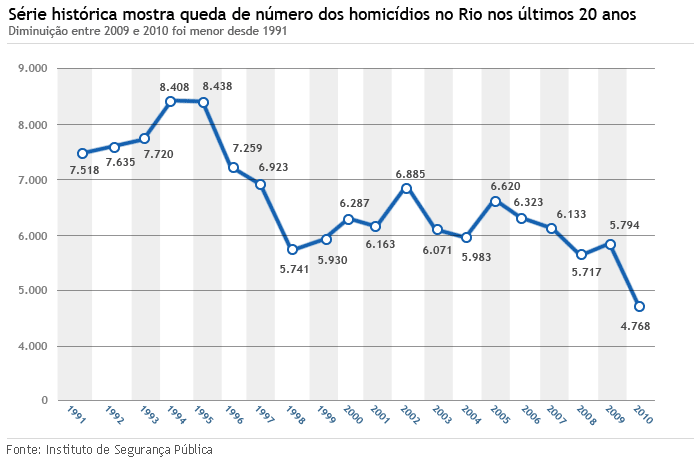
(Source, in Portuguese)
Monday, January 31, 2011
Poorest Brazilians are as poor as the world's poorest...
...and the richest Brazilians are as rich as the world's richest. Furthermore, the median Brazilian has an income close to the poorest 5% Americans.
Very cool graph (via Economix; I suggest the whole post):

The graph comes from "The Haves and the Have-Nots,” by Brancko Milanovic. (He is the coauthor (with Lindert and Williamson) of a great paper).
Very cool graph (via Economix; I suggest the whole post):

The graph comes from "The Haves and the Have-Nots,” by Brancko Milanovic. (He is the coauthor (with Lindert and Williamson) of a great paper).
Friday, January 28, 2011
China overtakes USA!!!
In 2008, the China's GDP per capita was US$6,725. This is a little bit higher than the GDP per capita of the USA... in 1928! Source: Maddison.
Monday, October 25, 2010
Commodity Lottery, XXI edition
The idea of a commodity lottery is well known among the students of Latin American economic history. It goes like that: the path of development that each country took was related to the characteristics of its main (natural resource based product) natural product exports: income elasticity and price, the possibility of linkages and global competition ... Exporting bananas or rubber is very different from exporting meat or coffee.
Well, now the argument of bad luck comes back. The great "New Economic Geographer" Gordon Hanson writes (via MR) in Why Mexico is not Rich? that the reason behind Mexico's misfortune is that its specialization pattern lies in goods similar to those of China.
Well, now the argument of bad luck comes back. The great "New Economic Geographer" Gordon Hanson writes (via MR) in Why Mexico is not Rich? that the reason behind Mexico's misfortune is that its specialization pattern lies in goods similar to those of China.
China’s size, high rate of growth, and increasing outward orientation mean that its emergence is surely changing international prices, improving the terms of trade for countries that produce its importables and deteriorating the terms of trade for countries that produce its exportables. Mexico fits squarely in the latter camp, whereas Argentina, Brazil, Chile, Colombia, and Peru fit in the former.
Friday, October 15, 2010
Services or Manufacturing. Which sector is the main driver of growth?
Bhagwati challenges the manufacturing fallacy. In addition, this article argues that the services sector played a major role in the revival of Indian manufacturing. (HT Escolhas e Conseqüências).
I am convinced that Colin Clark's division of the economy in three sectors is not that useful anymore. For instance, how much of a US$200 Nike shoe was produced in the services sector?
Friday, October 8, 2010
"Living Standards in Latin American History: Height, Welfare, and Development, 1750-2000 "
The book -just published!- is part of the David Rockefeller Center Series on Latin American Studies, is distributed by Harvard University Press , and it is available at Amazon. One of its papers is Growth and Inequalities of Height in Brazil, 1939-1981, an anthropometrical study written by Nogueról, Shikida and myself. A previous version of the paper is available here.
Wednesday, September 22, 2010
Melissa Dell "The Persistent Effects of Peru's Minning Mita"
...Using data from the Spanish Empire and Peruvian Republic toThe paper is awesome and it is forthcoming in Econometrica.
trace channels of institutional persistence, I show that the mita's inuence has persisted through its impacts on land tenure and public goods provision. Mita districts historically had fewer large landowners and lower educational attainment. Today, they are less integrated into road networks, and their residents are substantially more likely to be subsistence farmers.
The CV of Melissa Dell is impressive: she is a graduate summa cum laude at Harvard, has a doctorate from Oxford, Ph.D. candidate at MIT, ultra marathon runner (100 km), founder of a NGO in Peru ... and she has a severe vision impairment.
Friday, August 20, 2010
"Education Performance: Was It All Determined 100 Years Ago? Evidence From São Paulo, Brazil"
de Carvalho Filho, Irineu and Colistete, Renato P. (2010): Education Performance: Was It All Determined 100 Years Ago? Evidence From São Paulo, Brazil. Unpublished.
"This paper deals with institutional persistence in long-term economic development. We investigate the historical record of education in one of the fastest growing and most unequal societies in the twentieth century – the state of São Paulo, Brazil. Based on historical data from an agricultural census and education statistics, we assess the role played by factors such as land concentration, immigration and type of economic activity in determining supply and demand of education during the early twentieth century, and to what degree these factors help explain current educational performance and income levels. We find a positive and enduring effect of the presence of foreign-born immigrants on the supply of public instruction, as well as a negative effect of land concentration. Immigrant farm-laborers established their own community schools, and pressured for public funding for those schools or for public schools. The effects of early adoption of public instruction can be detected more than one hundred years later in the form of better test scores and higher income per capita. These results are suggestive of an additional mechanism generating inequality across regions: the places that received immigration from countries with an established public education system benefited from an earlier adoption of the revolutionary idea of public education."
Saturday, August 14, 2010
Monday, May 3, 2010
Saturday, March 20, 2010
North Korea, the worst place on Earth
- The former chief of the planning and finance department of the Workers' Party was executed;
- Reality X Fantasy.
Subscribe to:
Posts (Atom)